
If you’ve been following the Indian markets in 2026, you know we aren’t just an “emerging market” anymore. We are a global benchmark. For decades, the Indian bond market was like a private club—mostly for Indian banks and insurance companies. But the gates have officially swung open.
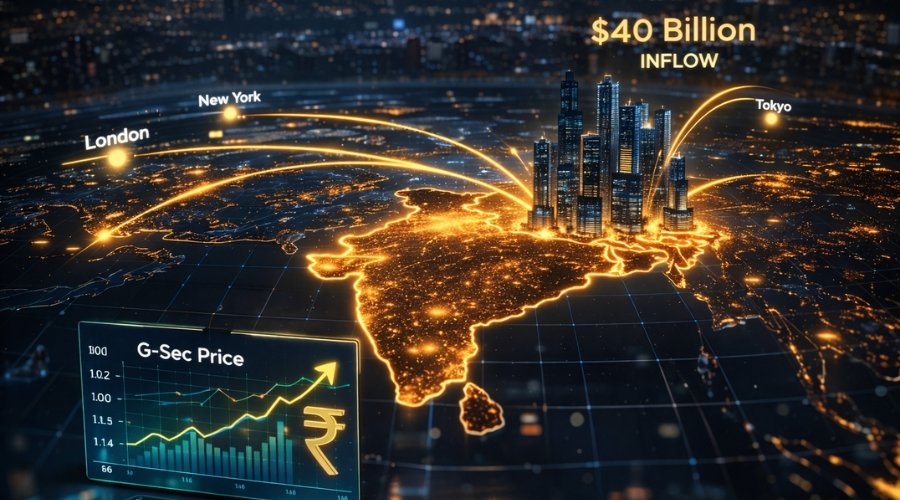
India’s inclusion in the major global bond indices—JP Morgan, Bloomberg, and potentially FTSE—is more than just a headline. It’s a structural shift that is bringing roughly $30–40 billion (nearly ₹3 Lakh Crore) of fresh, foreign “permanent” capital into our debt markets.
What’s Actually Happening? (The “Index” Secret)
Think of a global bond index like a “Must-Buy” list for the world’s biggest fund managers. If India is on that list, thousands of funds from New York to Tokyo are legally required to buy Indian Government Bonds (G-Secs).
This isn’t “hot money” that flees at the first sign of trouble. This is stable, passive capital that is here for the long haul.
Why Should You Care? The “Ripple Effect”
You might not buy a 10-year G-Sec yourself, but this inflow affects your wallet in three major ways:
- Your Debt Funds are Working Harder As foreign billions chase our G-Secs, the prices of those bonds go up, and the yields (interest rates) compress. If you hold a long-duration debt fund or a G-Sec fund, you’ve likely seen your returns jump as the market value of your holdings rose.
- Cheaper Loans for India Inc. When G-Sec yields fall, they set a lower “base” for everything else. This means Indian companies can now borrow money at lower rates to expand, hire, and grow. This is the “fuel” that’s helping drive our 7%+ GDP growth in 2026.
- A Shield for the Rupee Every dollar a foreign fund brings in to buy an Indian bond is a dollar added to our Forex reserves. This massive “buffer” helps keep the Rupee stable, even when the rest of the world is facing currency volatility. A stable Rupee means lower inflation for you.
The “FAR” Factor: The Digital Key
The reason this is all possible is the Fully Accessible Route (FAR). The RBI essentially created a special “fast-track lane” where foreign investors can buy bonds without the old, complicated quotas. In 2026, this system is running like a well-oiled machine, integrated with global clearing systems.
A Message for the Smart Investor
In the old days, we looked at bonds as “safety” or “lazy money.” In the post-inclusion era of 2026, bonds are a strategic play. * Duration Positioning: If you caught the “yield compression” early, you’ve made equity-like returns in a debt instrument.
- Diversification: With deeper liquidity and global participants, the Indian bond market is now one of the most resilient places to keep your wealth.
The Bottom Line
At Kanfincap, we’ve seen the Indian market evolve for over 20 years, but we’ve never seen a shift quite like this. India is no longer just “on the map”—we are the map.
Whether you’re a professional advisor or a family office in Gujarat, the “Index Inclusion” isn’t a one-time event to watch. It’s a new foundation to build on. The global world has arrived at our doorstep; it’s time to make sure your portfolio is ready to welcome them.