The Great Income Pivot of 2026: Why Your Cash Strategy Needs a Modern Upgrade
In the financial world, 2026 will be remembered as the year the “safe play” became the “static play.” For nearly a decade, we were conditioned to accept near-zero returns on our cash. Then came the volatility of the early 20s, which taught us to value security above all else. But today, as we navigate a landscape where the Reserve Bank has stabilized rates at a hawkish 3.85%, the game has changed.
The question is no longer just “Is my money safe?” but “Is my money working as hard as I did to earn it?”
For many professionals, the default answer has always been the humble Fixed Deposit (FD). It’s the financial equivalent of a sturdy pair of work boots, reliable, familiar, and virtually indestructible. But there is another contender that has quietly moved from the institutional shadows into the retail spotlight: Corporate Bonds. If you are currently sitting on a significant cash reserve, whether it’s a business exit, an inheritance, or simply the fruit of years of high-level salary, the choice between these two vehicles isn’t just about a few decimal points. It’s about the difference between passive growth and active stagnation.
1. The 2026 Yield Reality: Chasing the “Spread.”
Let’s look at the actual numbers as they stand today in February 2026.
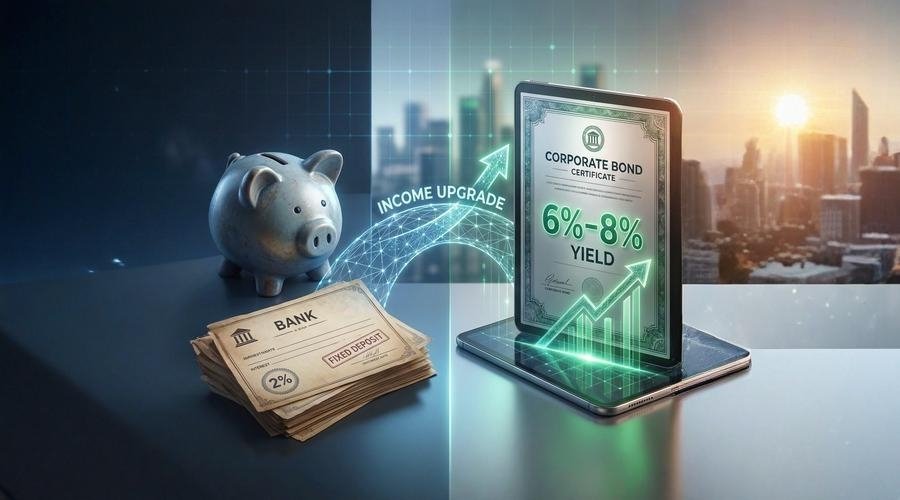
A “Big Four” bank will currently offer you a Fixed Deposit in the realm of 4.2% to 4.8% for a 12-month commitment. It’s a guaranteed win, but in a world of 3.5% “sticky” inflation, your real return on the money that actually buys you things is barely hovering above 1%.
Now, look at the Corporate Bond market. Investment-grade bonds from stalwarts, the retailers, utilities, and infrastructure giants we use every day, are yielding between 5.8% and 7.5%. For those willing to look at mid-tier firms with rock-solid balance sheets, that yield can push toward 8.5%.
This “spread” the 2% to 3% gap might sound small on paper. But on a $500,000 portfolio, we are talking about an extra $10,000 to $15,000 in annual income. That is a family holiday, a high-end education fund, or a massive injection into your primary wealth engine. In 2026, leaving that on the table isn’t just conservative; it’s an opportunity cost that compounds every single year.
2. Risk vs. Resilience: Sleeping Well While Your Money Works
I often hear from investors who say, “I’ll take the lower rate because the bank is safe.” And they aren’t wrong. The Australian Government’s Financial Claims Scheme provides a $250,000 safety net that makes Fixed Deposits the ultimate “sleep at night” asset.
But high-quality investing requires us to look at Resilience instead of just Safety. When you buy a Corporate Bond, you are the bank. You are lending your capital to a company with a contractual obligation to pay you back. If you lend to an “Investment Grade” company (rated BBB- or higher), you are lending to an entity that has likely survived recessions, global shifts, and tech disruptions. These companies have deep pockets and proven cash flows.
The risk isn’t that the world ends; the risk is that a specific company defaults. We manage this through Diversification. By spreading your capital across 10 to 15 different bonds in different sectors—say, a mix of a supermarket giant, a renewable energy provider, and a major logistics firm—you create a portfolio that is functionally more resilient than a single bank account.
3. The “Liquidity Trap”: Why Fixed Deposits Can Be Brittle
As a professional, your life is dynamic. Opportunities don’t always wait for your 12-month term deposit to “unlock.”
The highest hidden cost of a Fixed Deposit is its inflexibility. If a life-changing business opportunity or a dream market entry point appears, breaking an FD is a painful experience. Banks will often slash your interest as a penalty, essentially taking back the profit you’ve earned for the crime of needing your own money.
Corporate Bonds represent freedom. Because they trade on a secondary market, you can sell them. While the market price might move slightly based on interest rate shifts, you aren’t “handcuffed.” You can typically liquidate a bond holding and have the cash in your hand within 48 to 72 hours. In 2026, being “strike-ready” is a competitive advantage that a Fixed Deposit simply can’t provide.
4. The After-Tax Truth: What You Actually Keep
We all hate talking about the taxman, but it’s the only math that matters. Both bank interest and bond coupons are taxed at your marginal rate. However, because the starting “pie” of a bond is so much larger, the “net” outcome is vastly different.
Imagine you are in a 37% tax bracket:
- The FD Path: A 4.5% return becomes 2.84% after-tax.
- The Bond Path: A 6.5% return becomes 4.10% after-tax.
That is a 44% increase in your actual spending power. When you are building a passive income stream to supplement a high-pressure salary, that 44% difference is what allows you to reach financial independence years earlier.
5. Building Your 2026 “Income Ladder”
The most sophisticated way to approach this in 2026 is through Laddering. Instead of putting all your cash into one 5-year bond, you stagger them. Imagine having $100k maturing in 12 months, $100k in 24 months, and $100k in 36 months. This creates a “rolling” cash flow. Every year, a chunk of capital returns to you. If rates have gone up, you reinvest at the higher rate. If you need the cash for a lifestyle pivot, it’s there.
6. The 2026 Checklist: Making the Decision
So, which one wins? It depends on the “job” you have for that specific dollar.
- Use Fixed Deposits for your “Emergency Fund.” This is your “fire extinguisher” money. It needs to be guaranteed, instant, and boring. Keep 3-6 months of expenses here and don’t worry about the return.
- Use Corporate Bonds for your “Opportunity Fund” and “Passive Income Engine.” If you have capital you don’t need for at least 18-24 months, putting it in an FD is doing your future self a disservice.
Moving From Earner to Investor
In 2026, the gap between the “average” and the “optimized” has never been wider. Corporate bonds offer a bridge to a higher tier of financial resilience, giving you the yield of a pro and the liquidity of a trader.
Don’t let your capital sit idle. Whether you choose the absolute certainty of the bank or the superior cash flow of the corporate world, make the choice an active one. Your wealth isn’t just a number; it’s the fuel for your next chapter. Ensure you’re using the highest-octane fuel available.